Business 101 for CGT Startups Working with CDMOs: How CDAs and MSAs Shape Your Future Tech Transfer
Prepared by the Knowledge Sharing Workstream
Cell & gene therapy startups don’t just “outsource manufacturing.” In many cases, they outsource the only place the process truly exists in a reproducible way. That’s why, in CGT, the contracts you sign with a CDMO early, often when you’re still preclinical and moving fast, can end up defining what you actually own, what you can replicate, and how easily you can transfer your program later.
Two agreement types do most of this damage (or deliver most of the leverage): CDAs (Confidential Disclosure Agreements) and MSAs (Master Services Agreements). Founders and early BD/CMC leaders frequently treat them as paperwork. In reality, these documents quietly set the rules for your process know-how, improvements, data access, and your ability to change suppliers, long before anyone is negotiating a “real” deal.
This is Business 101 for CGT startups: you’re not just contracting services; you’re contracting the conditions under which your technology can be reproduced elsewhere.
The CDA: It’s Not “Just So We Can Talk”
CDMO conversations start with a CDA. It feels harmless: “we just need to share enough information so they can quote the work.” But in CGT, what you share during early discussions often includes precisely the ingredients that differentiate your process: vector strategy, upstream and downstream parameters, analytical approaches, potency assumptions, comparability logic, and early stability insights.
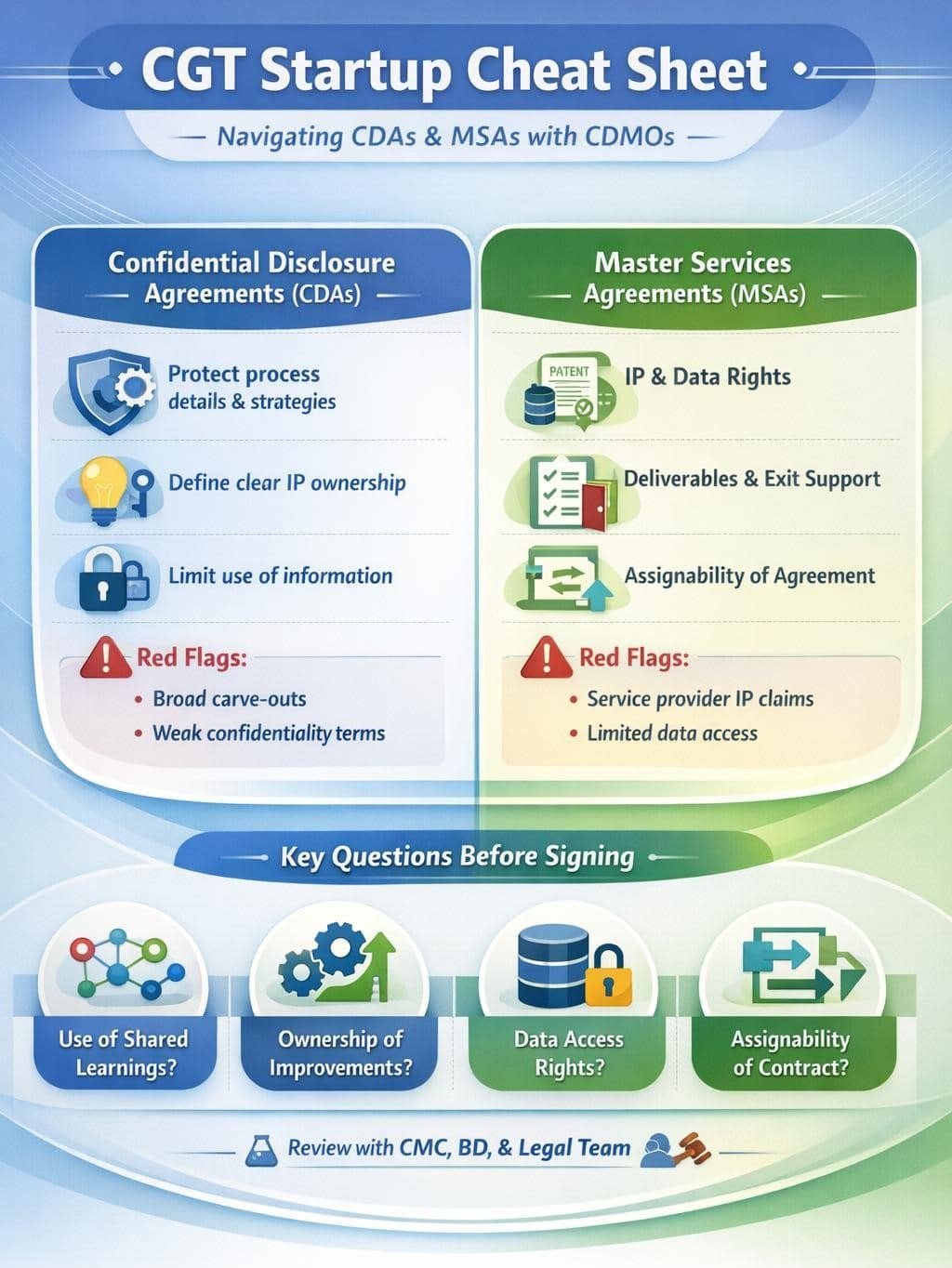
A good CDA does three simple things:
- Limits disclosure and use (not only disclosure).
- Defines what’s covered with enough clarity to protect process know-how and program-specific insights.
- Creates clean boundaries around what the CDMO can do with learnings derived from your information.
A bad CDA can let value leak out in ways that are hard to prove later. The most common culprit is some form of a “residuals” concept, language that permits the recipient to use information retained in memory (or “general knowledge”) even if the written materials are returned or destroyed. In normal vendor relationships, that’s a nuisance. In CGT, where every run produces learnings that improve yield, quality, and robustness, residuals can become an indirect permission slip for the CDMO to apply your hard-earned insights to other programs.
CDA red flags in CDMO settings
Here are CDA issues that become real later during tech transfer, diligence, or scale:
- Residuals / retained know-how language that effectively allows reuse of insights.
- No restriction on “use” (only restricts “disclosure”). That means the CDMO might be barred from sharing your information but not from using it internally as inspiration.
- Overbroad confidentiality exceptions (e.g., “information that becomes known to recipient” without clear limitations).
- Weak definition of Confidential Information that misses process parameters, “negative data,” or analytical learnings.
CDA “Business 101” mindset shift
When you sign a CDA with a CDMO, ask one question:
“If we never work with you, what prevents you from using what you learned from us?”
If the honest answer is “not much,” you’re potentially donating competitive advantage before you’ve even agreed on a scope.
The MSA: Where IP Control and Transferability Are Really Decided
Startups often negotiate the Statement of Work (SOW) intensely, timelines, batches, pricing, while the MSA is treated as “standard legal.” That’s backwards. In CDMO relationships, the MSA is the constitution: it governs ownership, improvements, access to data, and what happens when the relationship ends. The SOW is just a project plan.
In CGT, the single most important concept inside the MSA is: Who owns and controls improvements?
Background IP vs. Foreground IP (and why definitions matter)
Most MSAs separate:
- Background IP: what each party brings in.
- Foreground IP: what’s created during services.
That sounds straightforward, but definitions are where control is won or lost. If “Foreground IP” is defined broadly and the CDMO claims ownership by default, your process can drift into a zone where you’ve paid for development but don’t fully control the outputs. Even if your company technically owns “the product,” you might not own critical enabling methods, optimizations, or analytical improvements.
The “Improvements” trap
In CDMO MSAs, “improvements” language often decides whether you own:
- Process parameter optimizations
- Yield/quality enhancements
- Modified purification approaches
- Novel in-process controls
- Refined analytics or potency approaches
- Batch record refinements and deviations learning
If the MSA says improvements are “owned by the service provider” (or jointly owned without a clear license back), you may find yourself dependent on that CDMO to replicate your own process.
This isn’t theoretical, during scale-up or a supplier change, a startup may discover that what they believed was “our process” is actually a mixture of their know-how and the CDMO’s improvements.
Data rights: the hidden transfer blocker
Tech transfer lives and dies on data access. MSAs should clearly address:
- Right to raw data (not just summaries)
- Access to batch records, deviations, investigations
- Method transfer packages
- Comparability and validation reports
- Audit trail / data integrity considerations
A potential failure mode: the startup receives “reports,” but lacks the granularity needed to reproduce the process elsewhere without months of rework.
Termination and exit: “How do we leave?”
In a healthy relationship, nobody plans for a breakup, but everyone should design for it. The MSA should make exit manageable. If it doesn’t, you’re not just choosing a vendor; you’re potentially choosing a long-term dependency.
Key exit-oriented concepts include:
- Tech transfer assistance obligation (scope + reasonable rates)
- Defined timelines and delivery format for documents and data
- Clarity that the sponsor can use deliverables to manufacture elsewhere
- Protection against the CDMO claiming rights to sponsor’s program-specific process
In short: a sponsor should not have to renegotiate their freedom to operate at the moment they most need it.
Key aspects to consider that could have significant financial implications:
- Termination period: how long are you on the hook for monthly minimums and/or suite fees?
- Pass-through markup: Pass-through costs are typically 1/3 of total spending with a CDMO.
How These Agreements Show Up in Diligence (and in Valuation)
Investors and strategic partners increasingly diligence operational and legal readiness as a proxy for execution risk, especially in CGT where CMC delays can break programs.
When a buyer or investor reviews your CDMO contracts, they’re often asking:
- Can the company manufacture this elsewhere without legal obstacles?
- Does the CDMO own or control any essential improvements?
- Do we have clean rights to data needed for comparability and filings?
- Are the agreements assignable in an acquisition?
- Is there any “residual” or “general learnings” language that creates ambiguity?
Bad answers don’t always kill a deal, but they can lead to:
- Price adjustments
- Escrows
- Conditions precedent (e.g., “fix these rights”)
- Forced renegotiations with the CDMO at the worst possible time
The business reality is simple: transferable process control is strategic optionality, and optionality is value.
Practical “Business 101” Guardrails
You don’t need to be a lawyer to protect the company. You need a few operational instincts:
For CDAs
- Treat the first CDA as the beginning of IP hygiene.
- Ensure “use” is restricted, not just disclosure.
- Be cautious with residuals and “general knowledge” language.
- Word of caution: I have never seen a CDA adjudicated in my career, so try to get the CDA in place with minimal edits; most, if not all, CDMOs have templates that will satisfy everyone.
For MSAs
- Own or clearly license back improvements required to run your program.
- Don’t accept vague joint IP provisions without commercialization control.
- Demand clear, practical data rights and deliverables access.
- Build a clean exit path: tech transfer support, deliverables package, and sponsor rights to use.
If you get these right early, you preserve the ability to scale, dual-source, switch CDMOs, or partner without being boxed in. And in CGT, that flexibility is often the difference between a program that survives the clinic and one that stalls in CMC purgatory.


